
The Things You Learned Before You Had Words for Them
The messages that shaped you weren’t always spoken. But you absorbed them anyway. And they’re still making decisions for you today.

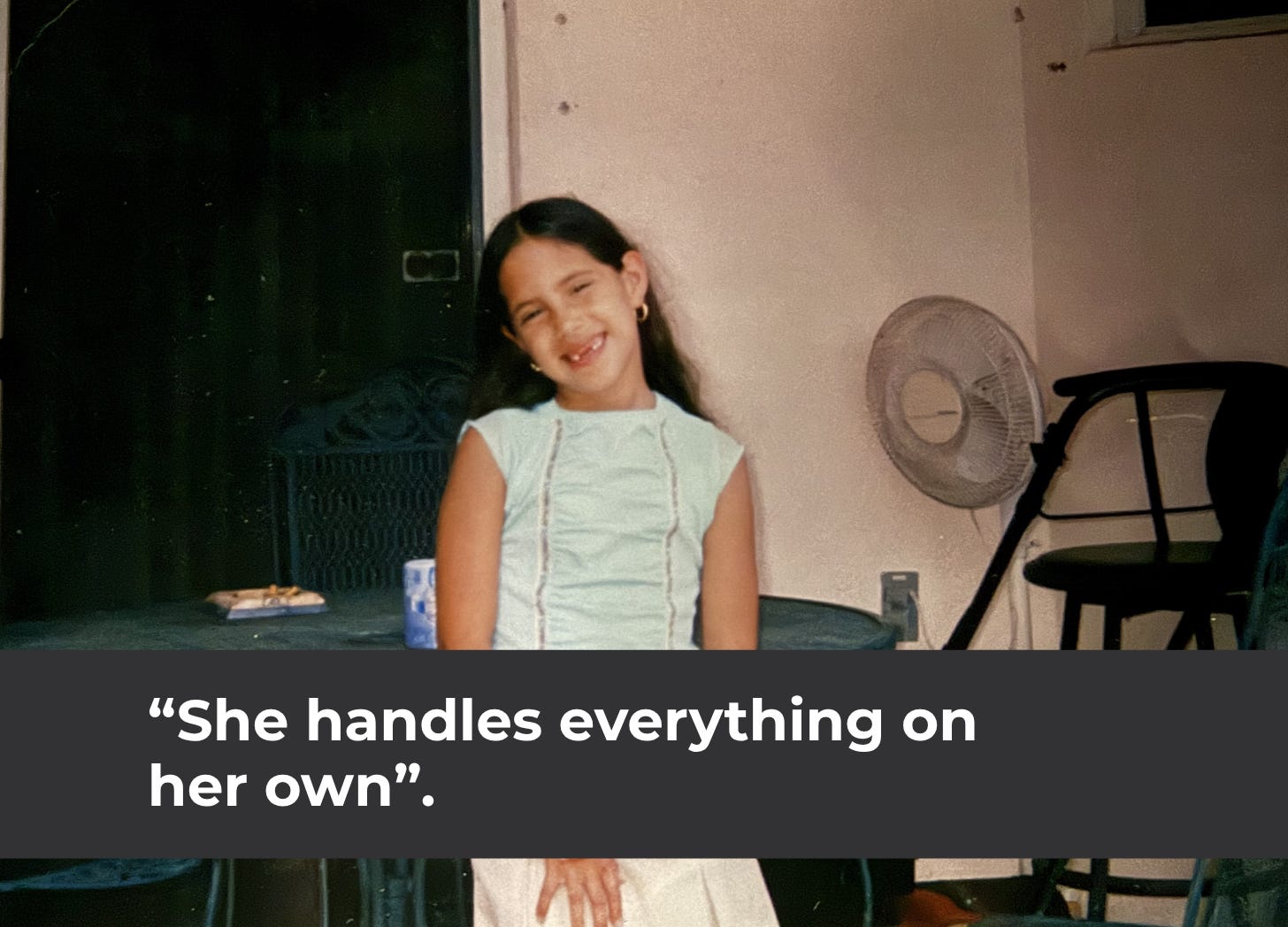
Nobody sat you down and said, “Here are the rules for being loved in this family.”
But you figured them out anyway.
You figured out which emotions were welcome and which ones made people uncomfortable. You figured out what earned praise and what earned silence. You figured out how to be the version of yourself that kept things stable, kept people happy, and kept you safe.
And you did ALL of this before you had the language to question any of it.
How the messages get in
Most of the beliefs running your life right now weren’t taught directly. They were absorbed through repetition, through tone, through what was celebrated and what was ignored.
Some of them may have even sounded like compliments.
“I never have to worry about her.”
“She’s so mature for her age.”
“She handles everything on her own.”
Some of them sounded like advice.
“Remember, you can’t fully rely on anyone.”
“You have to be strong and independent.”
“Don’t be so emotional.”
And some of them were rules that were spoken once and never questioned again.
My mom had something she called the 24-hour rule. If something upset you, you had 24 hours to feel it. After that, it was time to move on. She didn’t say it to be cruel. She said it because that was how she survived. I was too young to understand where that rule came from and that it stemmed from her own unresolved trauma that she was passing onto me as “wisdom”. But it made sense to me at the time… It sounded efficient, so I adopted it and learned that there wasn’t room for emotions that lingered.
And here is what that translates to: your emotions are an inconvenience. Feel them quickly or don’t feel them at all.
I became someone who processed fast, moved on faster, and judged herself for any feeling that lasted longer than it “should.”
The messages you didn’t know you were carrying
Here’s what makes this so hard to see: the messages don’t announce themselves. They disguise themselves as personality traits, as preferences, as “just the way I am.”
But when you slow down and look at the patterns you keep repeating, the messages start to surface.
“Don’t be too much.”
This one shows up as shrinking. Apologizing for having an opinion. Editing yourself before you speak. Keeping your excitement small because somewhere along the way, you learned that taking up space was wrong.
If you internalized this sort of message, you might notice that you dim yourself in groups, downplay your accomplishments, or feel physically uncomfortable when you’re the center of attention. You don’t do these things because you’re naturally “modest”. You do it because you learned that “too much” was the thing that made people pull away or resulted in a negative reaction.
“Be grateful for what you have.”
On the surface, this sounds like wisdom. But when it’s used to shut down dissatisfaction, it becomes a silencer. It teaches you that wanting more is ungrateful. That discomfort with your current life means something is wrong with you, not with the life.
If you internalized this message, you probably struggle to admit when something isn’t working. You talk yourself out of your own unhappiness. You stay in jobs, relationships, and situations that don’t fit because leaving would mean you’re not grateful enough for what you were given.
“You have to be strong. Never rely on anyone.”
This one builds a person who looks incredibly capable on the outside and is outrageously exhausted on the inside. It teaches you that needing help is a weakness. Asking for support is a burden to others. And the version of you that is most loved/respected is the one who can handle everything alone.
If you internalized this message, you might notice that you have a hard time receiving help even when it’s offered. You deflect compliments. You power through when you’re struggling because folding isn’t an option. And when you finally break, you feel ashamed of it instead of seeing yourself as a human who is allowed to have a limit.
“Don’t be so emotional.”
This one teaches you to distrust your own inner experience. It says: your feelings are unreliable, inflated even. They’re a problem to be managed, not information to be listened to.
If you internalized this message, you might intellectualize everything instead of feeling it. You rationalize and analyze your emotions instead of experiencing them. Chances are, you can explain your patterns with perfect clarity yet still feel completely disconnected from yourself.
What is most interesting about this is that the message was never “don’t feel.” It was actually “don’t let anyone see you feel.” And eventually, you stopped letting yourself see it, too.
“I don’t have to worry about her.”
This is the one that disguises itself as the highest praise. And for many women (like myself), it’s the one that did the most damage.
Because what a child hears is: the less you need, the more you’re loved. The less trouble you cause, the more valuable you are. The more invisible your needs, the safer your place in this family.
If you internalized this message, you probably became the low-maintenance friend, the easy partner, the employee who never complained. You built an entire identity around not being a burden. And now, every time you have a need, it comes with tsunami-sized guilt that feels completely disproportionate to what you’re asking for.
Why these messages are so hard to unlearn
These messages are hard to unlearn, or even begin to see, because they didn’t come from bad people. Most of them came from parents, caregivers, and families who were doing the best they could with what they had.
In my case, my mom wasn’t trying to teach me that my emotions were inconvenient. She was trying to teach me resilience with the only tools she had.
That’s what makes this work so complicated... You can love the people who shaped you and still recognize that some (or a lot) of what they gave you doesn’t serve you anymore.
You’re not betraying them by questioning these messages. You’re honoring yourself by finally asking: Is this still true? Was it ever true? Or was it just the best available strategy for a parent/caregiver/loved one with the knowledge and resources they had available?
And if no one has ever given you this permission, let me be the one to do it.
You are allowed to feel that you’ve outgrown these messages. To feel that you’ve learned better. To WANT to change your narrative about these things. To respect and act on that feeling in your body that makes you think “this doesn’t feel right for me anymore”.
The Question Worth Sitting With
Pick the message from this post that hit the hardest. The one you read and thought, “that one’s mine.” Then sit with one question:
How is this message still showing up in my decisions right now?
Not when you were 10. Not in your twenties. Right now. Today. This week.
You might see it in the way you said yes to something you didn’t want to do. In the way you swallowed your opinion in a meeting. In the way you apologized for asking for help. In the way you moved on from something painful before you were actually ready because your internal clock told you time was up.
That’s the message, still firing behind the scenes.
Seeing it clearly is the first step to choosing something different for yourself.
Where to Go Next
These childhood messages don’t just shape how you see yourself. They shape how you self-sabotage, which opportunities you go after, which ones you quietly talk yourself out of, and why. If you want to see which self-sabotage style your specific messages are built on, the quiz names it in about 3 minutes.
→ Take the free Self-Sabotage Style Quiz here.
Once you know your style, the Self-Sabotage Pattern Breaker Workbook is the 7-day system built around the specific moment your pattern takes over. It’s live now.
Know someone who keeps blaming herself for patterns she didn’t choose and hasn’t yet traced back to where they actually started? Send her this article.
Your words deeply resonated with me. Thank you so much for sharing your work here. I am honored to subscribe. 💜
This was a fantastic read and I resonate deeply with most of these messages. I’m still working through some, but I’m grateful to have grown past most now. 🖤