
What Flipping A House Taught Me About Shadow Work
The universe was not reading my project management notes.

There is a video on my phone of water pouring into our basement like a scene from a disaster movie.
Not a slow leak. Not a drip. Pouring.
We had just fired and rehired contractors for the third time. We were already behind schedule. Already over budget. And now I’m standing in someone else’s basement in shoes that were NOT made for this, watching money leave our lives in real time, thinking “this cannot be happening”.
That was a Wednesday, I think. Honestly, the days blurred together in a way I haven’t experienced before or since.
This is the story of our first house flip. And if you stay with me, the story of the most clarifying shadow work I have ever accidentally done.
Perfectionism is a constant, but it especially loves to show up when everything is falling apart, and people are watching. That’s when you find out what it’s actually made of.
And what it’s actually made of is fear. Specifically, the fear that if you can’t control how this looks, people will finally see the truth about you.
What perfectionism looks like when the universe stops cooperating
My partner and I bought our first investment property: a fix-and-flip. We had a plan. We had a timeline. We had people lined up to help us.
One by one, the plan stopped… Well, planning.
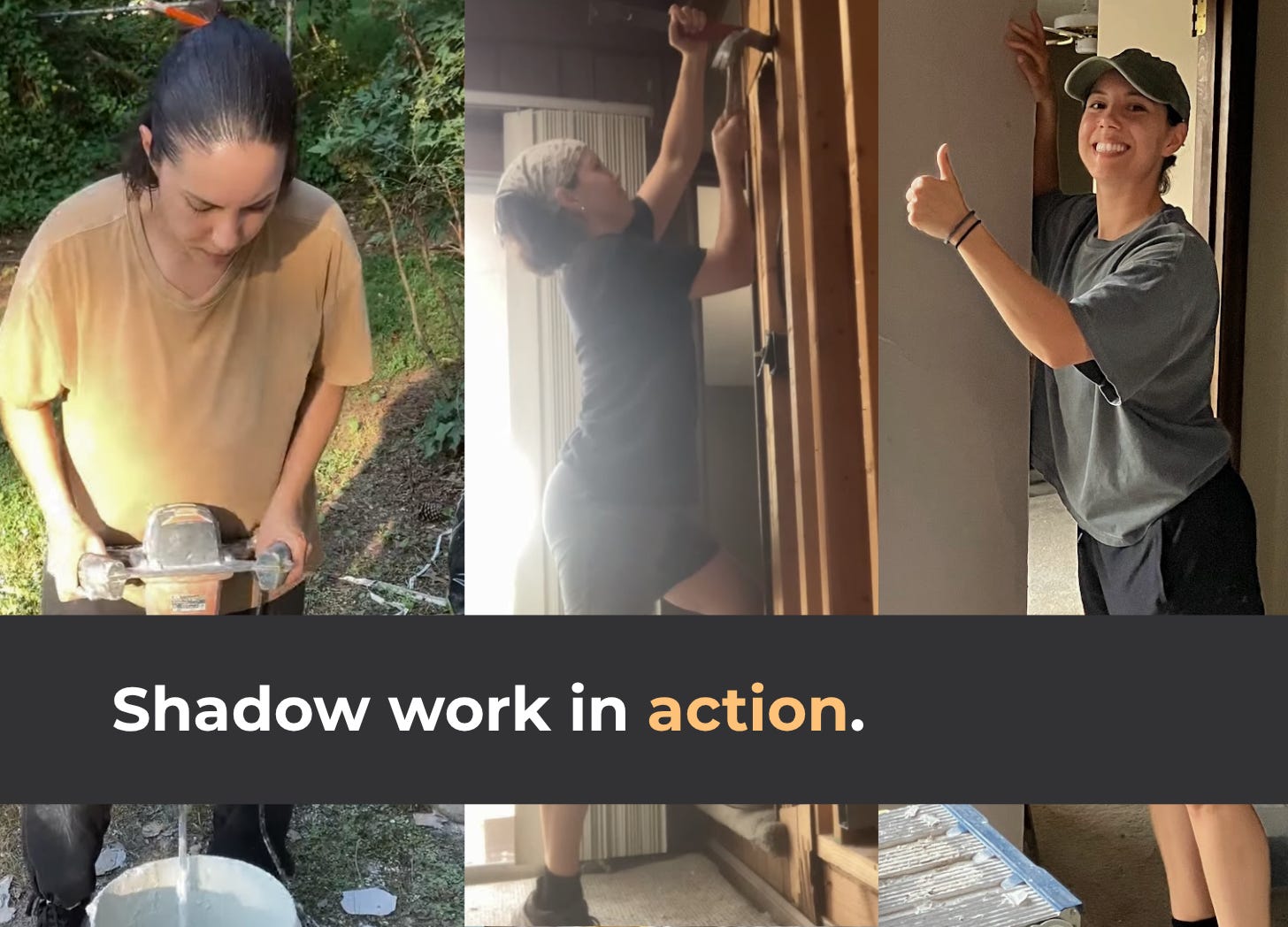
The contractors we hired weren’t doing the work correctly, so we let them go and found new ones. Then those ones had to go too. We were outsourcing, rehiring, managing timelines that kept shifting, and somewhere in the middle of all of that, we realized that if this house was going to get done, we were going to have to do a significant amount of it ourselves.
So that’s what we did.
That’s me. Covered in sanding dust. Wearing it like a second skin because at that point, it was basically permanent.
From the outside, I’m sure it looked like chaos. And honestly? From the inside, it felt worse. And people knew we were doing this. People were watching. And the version of the story they were seeing looked nothing like the version I had planned to show them.
That gap between the story I wanted to tell and the story that was actually happening was eating me alive.
Then the tree fell.
I need you to picture this.
We are close. Not done, but close enough that I can see the finish line. Close enough that I had already organized a meeting with our listing agent and was pitching dates to come photograph the house. Close enough that I have allowed myself, for the first time in months, to take a deep belly breath and a long open-mouth exhale.
And then a tree came down and ripped the power lines clean off the house.
Not just the house we were working on, but every house on the street.
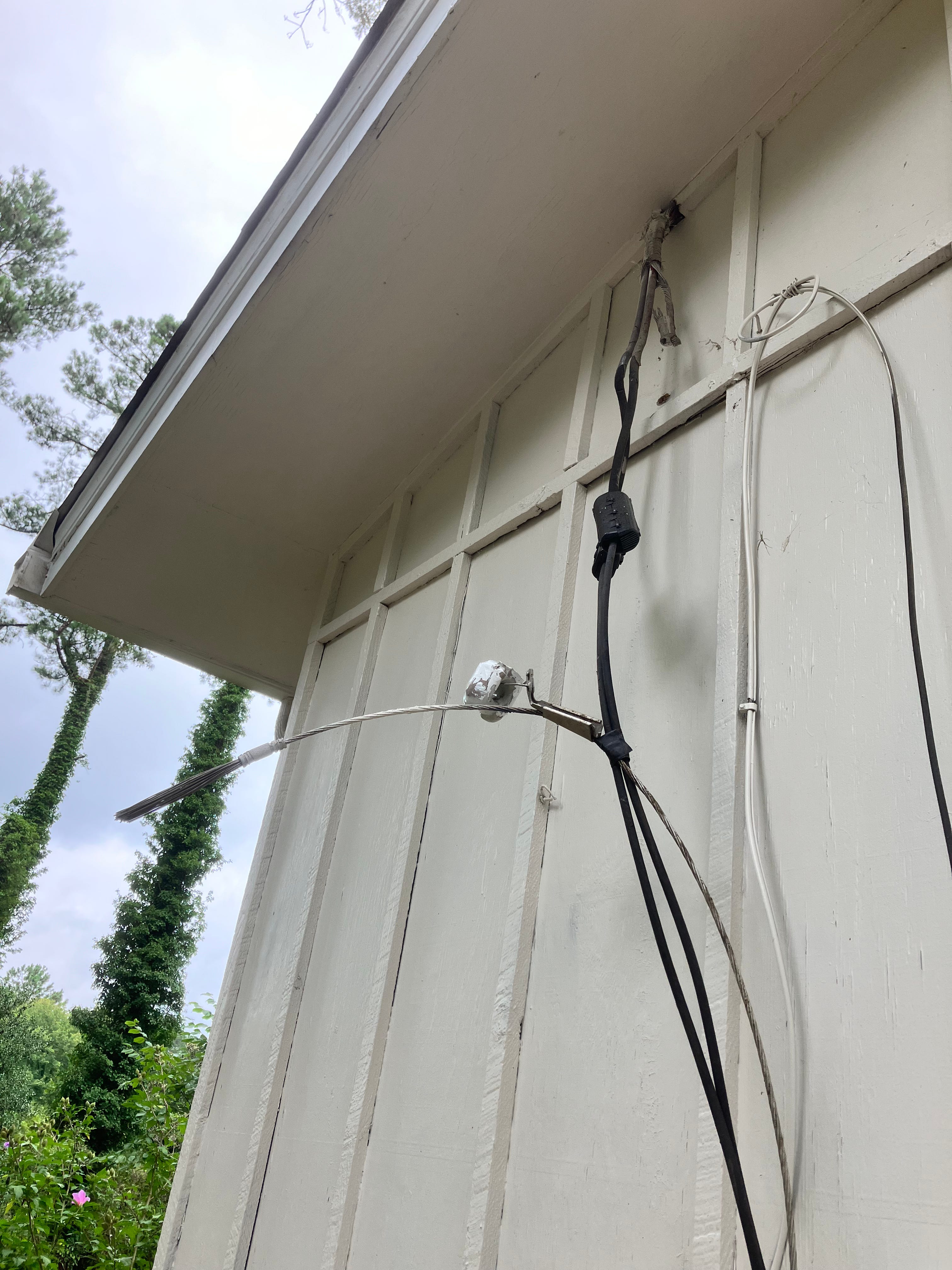
I stood there looking at those wires for a long time. There was nothing to do. You cannot out-plan a fallen tree. You cannot work harder to prevent power lines from going down.
For someone who had spent my entire life believing that enough preparation, effort, and control could prevent any disaster, that moment was its own kind of education.
The universe was not reading my project management notes.
Before we go further, a note on what shadow work actually is and isn’t.
Because I know what some of you are thinking. Shadow work sounds like lying on the floor, crying about your childhood for three hours. Or burning sage. Or something your favorite wellness influencer does on a Tuesday morning with a latte and a linen journal.
And let me be clear: Sometimes it is those things. Sometimes that’s exactly what is required. But it doesn't always look that way.
Shadow work is simply the practice of getting honest about the parts of yourself you’ve learned to hide. Think about the reactions you explain away, the patterns you keep repeating despite knowing better, and the internal rules you follow without ever actually agreeing with them. For some people, that process goes deep and gets painful and takes time. For others, it starts with a moment of observation or a question you finally let yourself answer.
What it is: a way of asking why — not to punish yourself with the answer, but to finally understand it.
The house flip was my why, showing up in steel-toed boots and a hard hat, completely uninvited.
What the basement and the tree were actually trying to show me
Here’s what I’ve come to understand about perfectionism after living through that flip:
Perfectionism is not about standards. It is not about caring deeply or wanting things to be good. Those are the stories we tell ourselves so we don’t have to look at what’s underneath.
What’s underneath is this: somewhere along the way, you decided that your worth was conditional on your output. That whatever you were reaching for (love, safety, or approval) was available to you only if you performed well enough, didn’t make mistakes, or could control how things looked.
For me, that decision was made very early. I was the kid who packed her own lunch, who aced tests nobody asked her to study for, who made herself easy and competent and low-maintenance because she figured out fast that this was how you stayed loved. Flawless performance wasn’t a choice. It was my survival strategy.
And survival strategies don’t retire just because you grow up and buy an investment property. They come with you. They show up in the way you lie awake in the middle of the night, calculating what people think when they look at your half-finished house. They show up in the way a fallen tree feels less like a logistical problem and more like a personal failure.
That’s the shadow. The part of you that decided a long time ago that imperfection meant danger. The part that is still, at 30-something, trying to protect you from a threat that doesn’t exist.
What shadow work for perfectionism actually looks like
I want to be specific here because “do shadow work” is the kind of advice that sounds profound and means nothing without some steps.
For perfectionism specifically, shadow work looks like this:
Journaling your worst-case scenario all the way to the end. Not stopping at “they’ll think I’m incompetent.” You have to go further. They think I’m incompetent, and then what? They tell someone, and then what? Everyone finds out, and then what? Keep going until you hit the actual fear at the bottom. Almost every time, it traces back to something that happened before you had the right words to question or explain it.
Investigating why you’re procrastinating. Perfectionism and procrastination are the same thing, wearing different sneaky outfits. When you can’t start or can’t finish something, ask yourself: What am I afraid people will see if this isn’t perfect? The answer is always about what the task represents.
Choosing done over perfect. On purpose. Practice deliberately feeling the discomfort of imperfection so your nervous system learns that nothing catastrophic will happen. We listed that house. We did the best we could with what we knew. Hell, we even painted the interior ourselves. I’m sure it would have looked much better done by professionals. But we listed it, it sold, and the world did not end.
Identifying whose voice your inner critic is using. The harshest voice in your head wasn’t you to begin with. It came from somewhere else: a parent, a teacher, or an environment that taught you that mistakes had consequences. Shadow work asks you to find that voice, name it, and understand that it was trying to protect you. And then gently, but firmly, let it know that you don’t need that kind of protection anymore.
The part I didn’t expect

We profited on that house.
The imperfect, contractor-fired, basement-flooded, power-line-severed, painted-by-hand house sold. And we made money on it.
I want to be careful not to wrap this up too neatly, because the lesson is not that “imperfection always works out.” Sometimes it doesn’t. Sometimes the basement really does ruin everything.
But the deeper lesson, the one I have come back to many times, is that the perfectionism didn’t protect me. The standards I held myself to, the sleepless nights, the spiral every time something went visibly wrong… None of that made the house better, made the house sell faster, or made the process less brutal. What got us through was not control. It was just continuing to show up in the mess, covered in sanding dust, doing the next thing.
The imperfect self, the one who doesn't have it together, the one covered in sanding dust with no idea what comes next, she was there the whole time.
And she's the one who actually finished the house.
That’s what shadow work eventually shows you. It’s not meant to show you that your standards are wrong, but that you were never as dependent on them as you thought.
Where to Go Next
Most people who recognize themselves in this article have been calling it perfectionism for years. That’s not wrong. But perfectionism is the behavior. The shadow is what’s underneath it. If you want to understand what’s actually driving it, this is the next essay worth reading.
→ Shadow Work Is Not What You Think It Is
Shadow work shows you where the pattern came from. But knowing the origin doesn’t always tell you how it’s showing up in your life right now. That’s what the Self-Sabotage Style Quiz is for. It takes the “why” you just uncovered and shows you the how: your specific behavioral pattern, the moment it tends to activate, and what it’s doing when it runs without your permission.
It takes about 3 minutes and it’s free. → Take the quiz here.
Know someone who keeps calling herself a perfectionist like it’s a personality trait and has never once asked where it came from? Send her this one.